The Ultimate Prime Rib Roast Oven Method
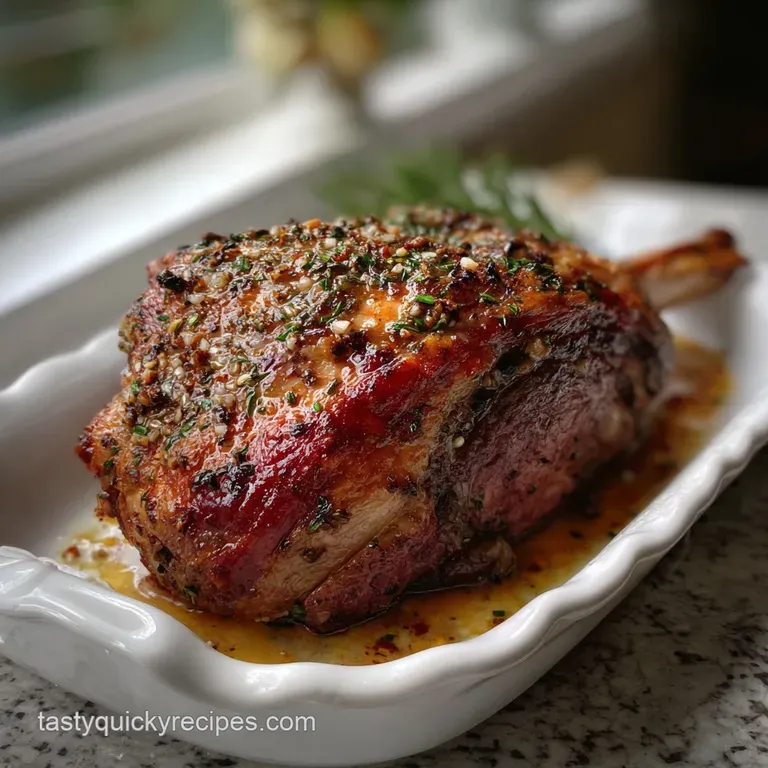
- Effort/Time: Low-active effort; 3 hour 20 mins total.
- Flavor Hook: Garlic-rosemary herb crust with a concentrated red wine au jus.
- Perfect for: High-stakes holiday dinners and make-ahead celebratory feasts.
- Achieving Restaurant-Quality Results with Your Prime Rib Roast Oven
- Thermodynamic Precision and the Science of Beef Flavor
- Critical Logistics for This Prime Rib Roast Oven Method
- Flavor Architecture and the Chemistry of Meat Seasoning
- Essential Toolset for Professional Prime Rib Results
- The Atomic Execution Protocol for Maximum Juiciness
- Solving Texture Failures and Gray Banding Issues
- ⚗️ The Scaling Lab: The Physics of Quantity
- Exploring Alternative Flavor Profiles for Your Roast
- Longevity Protocols for Remaining Prime Rib Portions
- Culinary Pairings and Finishing Touches for Your Meal
- Recipe FAQs
- 📝 Recipe Card
Achieving Restaurant Quality Results with Your Prime Rib Roast Oven
There is nothing more gut-wrenching than pulling a $180 prime rib roast oven out of the heat only to find it has been reduced to the texture of a gray, dry cardboard shipping container.
You spend the money, you spend the time, and yet the "guesswork" of traditional over high heat methods often results in a center that is raw and edges that are parched. I once served a roast so unevenly cooked that half the table was eating beef tartare while the other half chewed through shoe leather; the emotional and financial cost of that failure changed how I approach beef forever.
I spent years obsessing over the physics of heat transfer, destroying several test batches by rushing the tempering process before I finally understood how protein fibers respond to thermal stress. I used to think a hotter oven meant a better crust, but I was wrong.
The secret to that shattering, mahogany exterior isn't high heat at the start; it's the patience to let the meat’s internal temperature rise with surgical precision before introducing the final sear.
The scientific revelation lies in protein denaturation and the reverse sear philosophy. By using a low-temperature environment, we allow the 8 lb prime rib roast (3 to 4 bone) to cook through without contracting the muscle fibers so violently they squeeze out all their moisture.
The result is a velvety, buttery texture accompanied by a concentrated "sizzle" from the garlic herb rub that hits your senses long before the first slice hits the plate.
Thermodynamic Precision and the Science of Beef Flavor
The success of this prime rib roast oven protocol relies on several key scientific mechanisms that guarantee success:
- Reverse Sear Equilibrium: Starting low (225°F-250°F) prevents the exterior from reaching 212°F (boiling) too quickly, allowing the center to catch up without the outer layers overshooting the medium rare mark.
- Enzymatic Tenderization: In the 100°F to 120°F zone, cathepsins (natural enzymes) are hyper active, breaking down connective tissue before the heat eventually neutralizes them.
- Surface Dehydration: Leaving the roast uncovered in the fridge for 24 hours (dry-brining) removes surface moisture, which means the final over high heat blast creates a shatter crisp crust rather than steaming the meat.
- Capillary Action and Resting: Resting allows the internal pressure of the roast to stabilize, letting the liquid reabsorb into the fibers so it doesn't hemorrhage across your cutting board.
Critical Logistics for This Prime Rib Roast Oven Method
Managing a large scale protein requires attention to thermal mass and timing. Use these specs as your roadmap for the 8 lb prime rib roast (3 to 4 bone).
| Metric | Value |
|---|---|
| Yield | 8 servings |
| Prep Time | 20 minutes |
| Cook Time | 3 hours |
| Total Time | 3 hours 20 mins |
| Target Internal Temp | 120°F (for Medium Rare after rest) |
Flavor Architecture and the Chemistry of Meat Seasoning
The ingredients listed below aren't just for flavor; they are functional components that interact with the beef's chemistry.
- 8 lb prime rib roast (3 to 4 bone): Why this? Bones act as thermal insulators, protecting the meat from direct heat.
- 3 tbsp Diamond Crystal Kosher Salt: Why this? Denatures surface proteins to create a "sticky" surface for the rub.
- 0.5 cup unsalted butter, softened: Why this? Provides a fat medium to carry fat-soluble herb compounds into the meat.
- 6 cloves garlic, minced: Releases allicin for pungent, savory depth.
- 2 tbsp fresh rosemary, finely chopped: High in volatile oils that withstand roasting.
- 1 tbsp fresh thyme, finely chopped: Adds earthy notes that complement the beef’s iron rich flavor.
- 2 tsp freshly cracked black pepper: Provides a textural bite and mild heat.
- 2 cups beef bone broth: High collagen content creates a silky, mouth coating au jus.
- 0.5 cup dry red wine: Acidity balances the heavy fat content of the prime rib.
Ingredient Chemistry Breakdown
| Ingredient | Chemical/Physical Role (Science) | The Pro Secret (Why This Matters) |
|---|---|---|
| Kosher Salt | Osmotic pressure & protein denaturation | Draws out moisture, dissolves it, then re-absorbs as a brine. |
| Rosemary/Thyme | Terpene infusion via fat solubility | Volatile oils dissolve into the butter rub, coating every fiber. |
| Red Wine | Acidic deglazing of Maillard fond | Dissolves the caramelized protein bits (fond) from the pan bottom. |
| Beef Bone Broth | Gelatin rich thickening agent | Natural collagen provides body to the sauce without needing flour. |
Essential Toolset for Professional Prime Rib Results
- Lodge Cast Iron Roasting Pan: Superior heat retention for the final sear.
- ThermoWorks ChefAlarm: A probe thermometer is non-negotiable for monitoring internal temps in real time.
- Victorinox 12 inch Slicing Knife: Long, thin blade ensures clean slices without tearing the delicate grain.
- Kitchen String/Twine: Essential for tying the roast to ensure even cylindrical cooking.
The Atomic Execution Protocol for Maximum Juiciness
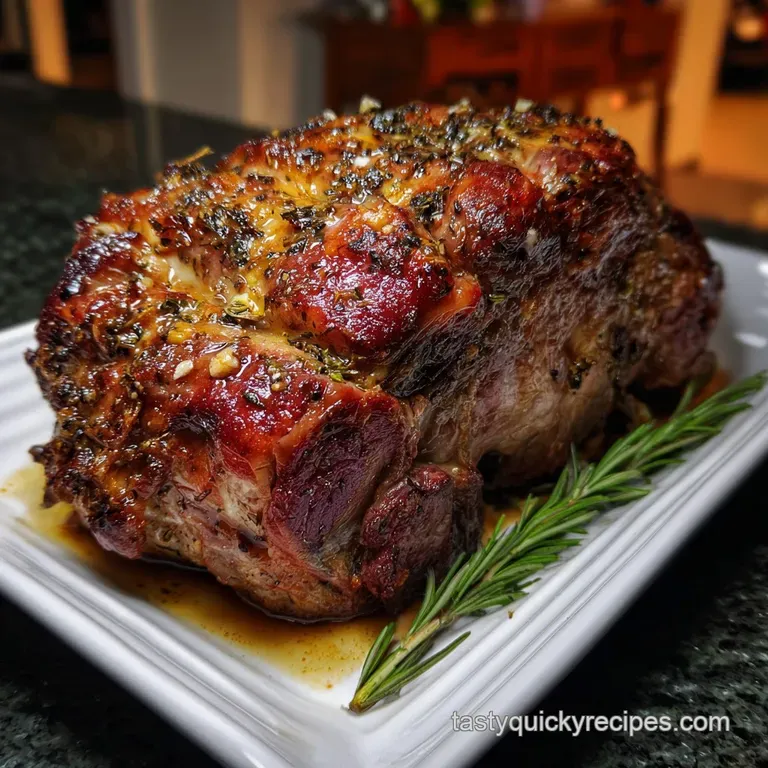
Follow these steps exactly. Each action is designed to maximize the "prime rib roast oven" potential.
- Season the 8 lb roast with 3 tbsp Diamond Crystal Kosher Salt 24 hours in advance. Note: This dry-brine period allows salt to penetrate deep into the muscle.
- Temper the meat by leaving it on the counter for 2 hours until the chill vanishes and it reaches near room temperature.
- Combine 0.5 cup unsalted butter, minced garlic, rosemary, thyme, and pepper in a small bowl.
- Slather the herb butter over the entire roast until a thick, opaque green and white paste coats every inch.
- Insert the probe thermometer into the thickest part of the meat until the tip reaches the dead center, avoiding bone.
- Roast at 250°F (120°C) for approximately 3 hours until the internal temperature hits 120°F (49°C) for medium rare.
- Remove the roast from the oven and tent with foil for 30 minutes until the internal temperature rises to 125°F-130°F via carryover heat.
- Simmer 2 cups beef bone broth and 0.5 cup red wine in a saucepan until the liquid reduces by half and smells intensely savory.
- Crank the oven to 500°F (260°C) and return the rested roast for 6 10 minutes until the exterior is a deep mahogany and the fat is hissing.
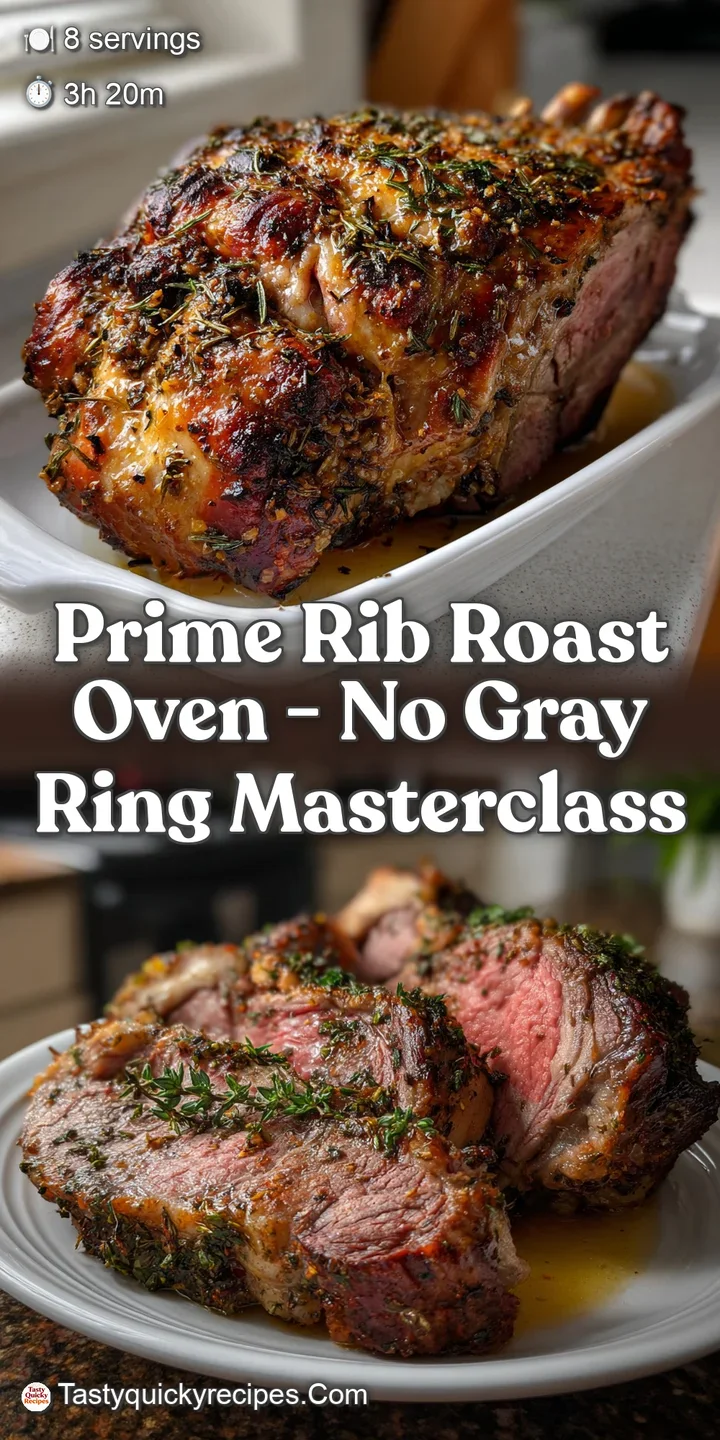
- Slice between the bones into 1 inch thick slabs until the velvety pink center is revealed.
If you're looking for another slow cooked masterpiece, my French Roast Recipe uses a similar low and slow approach for incredible tenderness.
Solving Texture Failures and Gray Banding Issues
Why Your Prime Rib is Tough
This usually happens because the oven was too hot, causing the muscle fibers to contract like a tight fist. When protein denaturation occurs too rapidly, the moisture is squeezed out, leaving the meat "stringy" even if it's pink.
| Problem | Root Cause | The Fix | Pro Protocol |
|---|---|---|---|
| Gray Ring | Oven temp too high early on | Lower the oven to 225°F | Aim for a 3 4 hour cook time. |
| Soggy Crust | Surface moisture remained | Dry-brine for 24 hours | Use a wire rack for airflow. |
| Juice Loss | Sliced too early | Rest for at least 30 mins | Never skip the foil tented rest. |
⚗️ The Scaling Lab: The Physics of Quantity
When you decide to cook two 8 lb roasts instead of one, you cannot simply double the time. Physics dictates a different approach.
- The Square Cube Law: Two roasts in the same oven create a massive heat sink. The air temperature will drop significantly when you first slide them in. Expect the cook time to increase by 20 30% as the oven struggles to maintain its set point against the cold mass.
- Pan Crowding: If the roasts are touching, they will steam each other's sides. Keep at least 3 inches of clearance between them to allow the hot air (convection) to reach all surfaces.
- Flavor Saturation: While the recipe calls for 3 tbsp salt, if you are doing a 16 lb roast, use 4.5 tbsp (1.5x) rather than 6 tbsp. Salt intensity increases non-linearly on large surface areas.
- Carry Over Cooking: A larger mass of meat holds more energy. A double roast will continue to rise in temperature for longer after it leaves the heat. Pull it 2 3 degrees earlier than a single roast.
Exploring Alternative Flavor Profiles for Your Roast
If you want to deviate from the classic herb butter, consider these variations:
- Horseradish Crust: Mix 3 tbsp prepared horseradish into the butter rub. It provides a sharp, sinus clearing bite that cuts through the rich fat.
- Espresso Rub: Add 1 tbsp finely ground espresso to the salt and pepper. This deepens the Maillard reaction, resulting in a darker, more "shatter crisp" crust.
- dairy-free Option: Swap the unsalted butter for high-quality duck fat or tallow. This will change the flavor profile to be more intensely "beefy" while maintaining the necessary fat barrier for roasting.
For a completely different way to use this flavor profile, try the San Giorgio Lasagna Recipe which mimics that classic Sunday roast comfort.
Longevity Protocols for Remaining Prime Rib Portions
Store your leftovers with care to avoid turning that "prime rib roast oven" success into a rubbery disappointment.
- Fridge: Store in an airtight container for up to 4 days. Wrap tightly in plastic wrap first to prevent the air from oxidizing the fat.
- Freeze: Slice the meat first. Freeze in vacuum sealed bags for up to 3 months.
- Reheating: This is critical. Do not microwave. Place slices in a baking dish with a splash of bone broth, cover tightly with foil, and warm at 250°F until the meat is just warm to the touch (about 120°F).
💡 ZERO WASTE PHILOSOPHY: Don't discard the rib bones. Transform: Simmer them with veggie scraps for 6 hours to create a fortified beef stock.
Science: The marrow and connective tissue release gelatin and minerals that provide a richer mouthfeel than any store-bought broth.
Culinary Pairings and Finishing Touches for Your Meal
Serving this prime rib roast oven requires sides that can stand up to its intensity.
- Classic Pairings: Serve with a dollop of cold horseradish cream and a side of buttery mashed potatoes.
- The Au Jus: Ensure the red wine reduction is served piping hot. The heat of the sauce will slightly warm the meat if it cooled too much during the rest.
- Leftover Idea: If you have meat left over, I highly recommend using it in my Leftover Prime Rib Recipes for a 30 minute Monday night meal that tastes like it took all day.
Common Myths Debunked:Myth: Searing at the beginning "locks in the juices." Truth: Searing creates flavor via the Maillard reaction, but it does nothing to prevent moisture loss.
In fact, high initial heat often causes more juice loss by tightening the outer fibers too early.
Trust the process, use your thermometer, and let the prime rib roast oven method do the heavy lifting for you. Let's crack on!
Recipe FAQs
how to make prime rib oven roast?
Use a low-temperature reverse sear method starting at 250°F for even cooking. This decouples internal temperature from crust formation, preventing the gray ring. If you enjoyed mastering low-and-slow thermal control here, see how the same principle works in our Prime Rib Roast Recipe: The Ultimate Slow Roast.
how to cook a prime rib roast oven?
Insert a probe thermometer into the thickest center spot. Roast low (250°F) until the probe reads 120°F for medium rare, then rest, and finally blast at 500°F for a 10-minute crust.
how to cook a prime rib oven roast cap off?
Remove the fat cap for direct crust contact. Without the cap, the herb rub adheres directly to the muscle, resulting in a far crispier exterior during the final high heat blast.
how to cook a prime rib oven roast in a slow cooker?
Slow cookers are generally unsuitable for large roasts needing a crisp crust. The moisture creates a steaming environment, which prevents the necessary Maillard reaction for browning. For a slow method using an oven, try the reverse sear detailed in our Ribeye Roast: The Foolproof Herb Crusted Reverse Sear Method.
how to cook a prime rib oven roast convection oven?
Set convection fans to 250°F for the initial low cook. Convection circulates heat faster, potentially reducing the low-temp cooking time by 10-15 minutes compared to conventional heat. Ensure the roast is on a rack for even air flow around the entire surface.
How do I ensure a perfect, juicy interior?
Rest the roast fully tented for 30 minutes post cooking. Resting stabilizes internal moisture pressure, allowing juices to redistribute rather than leak out immediately upon slicing. Failure to rest causes the muscle fibers to seize upon cutting, expelling the liquid.
- Pull roast 5 degrees before target
- Tent loosely with foil
- Carryover heat completes the cook
Should I sear first or roast first?
Roast first using the reverse sear method. Searing first sets the exterior temperature too high too fast, leading to a thick gray band before the center reaches medium rare. The reverse sear ensures even doneness from edge to edge.
Prime Rib Roast Oven Mastery
Ingredients:
Instructions:
Nutrition Facts:
| Calories | 942 kcal |
|---|---|
| Protein | 76g |
| Fat | 68g |
| Carbs | 3g |
| Fiber | 1g |
| Sugar | 0.5g |
| Sodium | 1380mg |
